Water Pump Hose Nipples: Reliable Connections for Pumps, Plumbing and Fluid Transfer
Water Pump Hose Nipples: Reliable Connections for Pumps, Plumbing and Fluid Transfer
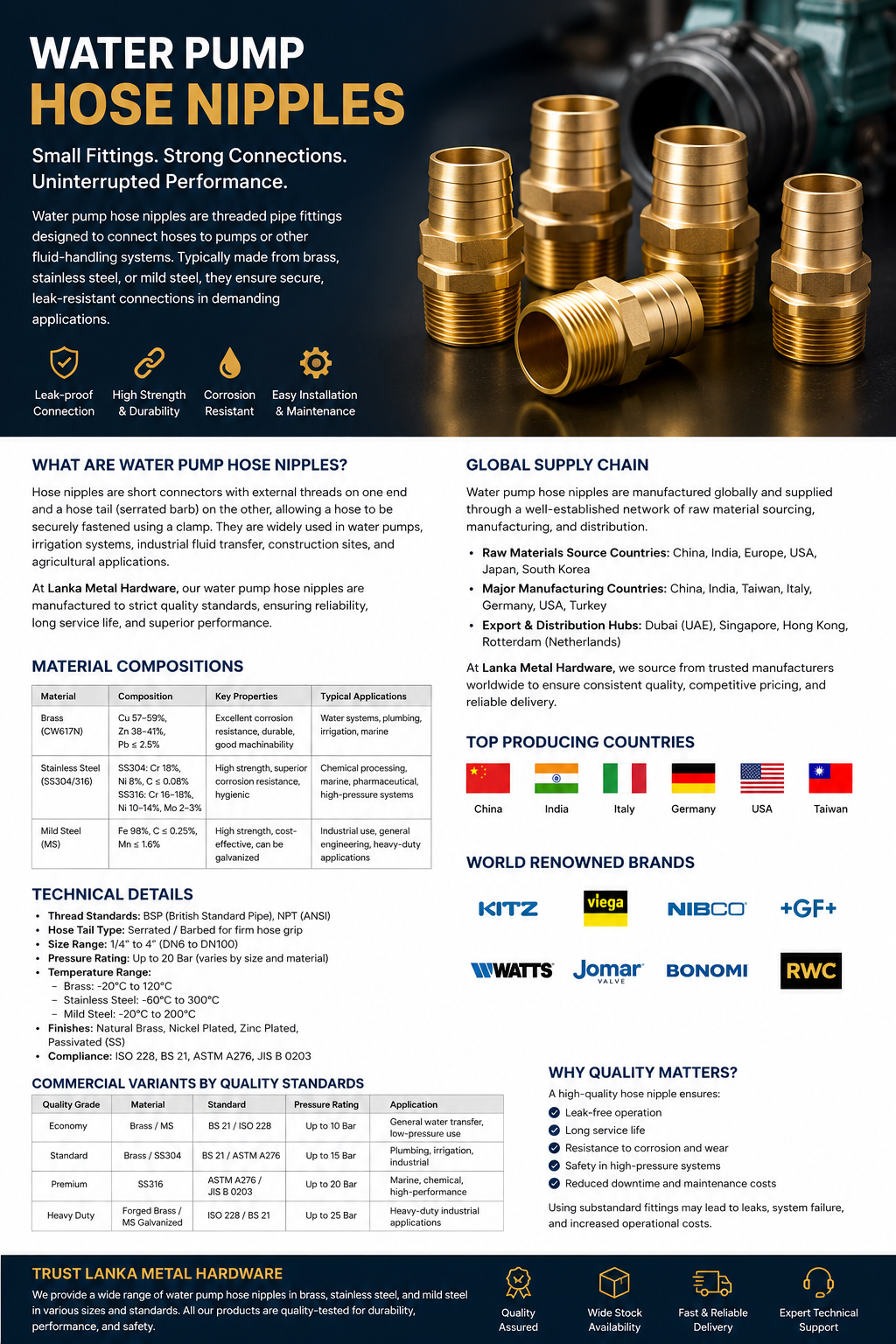
Water pump hose nipples are compact but essential threaded fittings used to connect flexible hoses to water pumps, pipes, valves and other fluid-handling equipment. A typical hose nipple combines a male threaded connection on one side with a barbed or serrated hose tail on the other. The threaded end connects to a pump outlet, valve or pipe fitting, while the hose tail provides a secure grip inside the hose and is normally secured with a suitable hose clamp.
For applications ranging from domestic water pumps and agricultural irrigation to industrial fluid-transfer systems, selecting the correct material, thread type, dimensions and pressure rating is important for achieving a reliable, leak-resistant connection.
Brass Hose Nipples and Accessories
Brass is one of the most widely used materials for water pump hose nipples because it provides a useful combination of corrosion resistance, strength, machinability and durability. Brass fittings are particularly suitable for water, plumbing, irrigation and general-purpose pump applications.
A commonly used European brass alloy is CW617N (CuZn40Pb2). Its composition is typically around 57–59% copper, with zinc making up the balance and approximately 1.6–2.5% lead, together with small quantities of iron, tin, nickel and aluminium.
Depending on the application, brass hose nipples can be supplied with accessories such as hose clamps, adapters, reducers, bushes, unions, washers and sealing components. Nickel- or chrome-plated versions may also be selected where additional surface protection or a particular appearance is required.
Technical Details
Water pump hose nipples are available in different configurations to suit pump and hose requirements. Important specifications include:
- Materials: Brass, stainless steel 304/316 and mild/carbon steel
- Thread systems: BSP, BSPT, BSPP, NPT and metric threads
- Hose connection: Barbed, serrated or grooved hose tail
- Common sizes: Approximately 1/4 inch to several inches, depending on application
- Finishes: Natural brass, nickel plated, chrome plated, zinc plated or passivated stainless steel
- Applications: Water pumps, irrigation, plumbing, agricultural systems, industrial fluid transfer and general engineering
BSP and NPT should not be treated as interchangeable thread systems. Parker’s fitting documentation identifies BSPT, BSPP and NPT/NPTF as different thread standards, while ISO 228 is associated with parallel pipe threads and ISO 7 with pressure-tight tapered pipe threads.
The actual working pressure of a hose nipple depends on its material, size, hose construction, clamp or connection method and the manufacturer’s rating. Therefore, a fitting should always be selected according to the complete hose-and-fitting assembly rather than the nipple alone.
Material Options
Brass: Excellent for general water applications, plumbing, irrigation and pump connections. It offers good corrosion resistance and excellent machinability.
Stainless Steel 304: Provides higher corrosion resistance and strength than conventional brass or mild steel, making it suitable for demanding environments.
Stainless Steel 316: Offers enhanced corrosion resistance and is commonly selected for marine, chemical-processing and other aggressive environments. Commercial manufacturers such as Parker and Dixon offer stainless-steel hose fittings in multiple thread configurations.
Mild/Carbon Steel: A cost-effective option for industrial applications. Depending on the environment, zinc plating or another protective finish may be applied.
Global Supply Chain and Manufacturing Countries
The global hose-fitting supply chain includes raw-material producers, brass-bar manufacturers, forging and machining companies, finishing facilities, exporters and regional distributors. China and India are major production centres, while Italy, Germany, Turkey, Taiwan, the United States and other industrial economies also contribute to the international supply of fittings.
Available trade data shows particularly strong export activity from China and India, while Italy and other European manufacturers are important suppliers of higher-precision and specification-driven fittings.
China has extensive manufacturing clusters for brass and hose fittings, particularly around Zhejiang and other industrial regions. India is also a major source of brass fittings, with Jamnagar in Gujarat being an important manufacturing centre for machined brass components.
For Sri Lankan buyers, international sourcing can therefore provide several quality and price levels, from economical general-purpose fittings to premium European and industrial-grade products.
Commercial Variants by Quality
Hose nipples can broadly be classified into several commercial quality levels:
Economy Grade: Usually manufactured from standard brass, mild steel or other cost-effective materials. Suitable for basic, low-pressure water-transfer applications.
Standard Grade: Better dimensional accuracy, thread quality and surface finishing. Suitable for domestic plumbing, irrigation and general pump installations.
Premium Grade: Manufactured from higher-grade brass or stainless steel with tighter dimensional control and improved corrosion resistance. Suitable for commercial and industrial applications.
Heavy-Duty/Industrial Grade: Designed for demanding fluid-transfer applications and may incorporate forged bodies, higher-grade stainless steel or heavy-wall construction. Pressure ratings must be verified against the manufacturer’s technical documentation.
Quality should not be judged by appearance alone. Thread accuracy, material certification, dimensional tolerances, pressure testing, corrosion resistance and traceability are all important considerations.
Internationally Recognised Brands
The global fluid-connection market includes established manufacturers such as Parker Hannifin, Dixon Valve, Gates and other specialist fitting manufacturers. Parker, for example, offers fittings using steel, stainless steel and brass and supports multiple international thread systems including BSP, NPT, metric and JIS configurations. Dixon likewise provides a broad range of hose fittings and clearly distinguishes between BSP, NPT, NPSH and other thread systems.
When purchasing branded or imported products, customers should check the manufacturer’s catalogue for the exact material grade, thread specification, pressure rating and intended application.
Choosing the Correct Hose Nipple
Before purchasing a water pump hose nipple, check five key points: hose internal diameter, pump connection thread, material, operating pressure and operating environment. A correctly matched fitting provides better sealing, reduces the risk of hose separation and helps prevent leakage and unplanned maintenance.
At Lanka Metal Hardware, water pump hose nipples and related brass accessories can be selected according to the requirements of domestic, agricultural, commercial and industrial applications. Choosing the correct fitting and compatible hose-clamping method helps create a dependable connection and extend the service life of the pumping system.
For product availability and specifications, visit the Water Pump Hose Nipples product page on Lanka Metal Hardware. Lanka Metal Hardware – Water Pump Hose Nipples